




























































With water, anything is possible
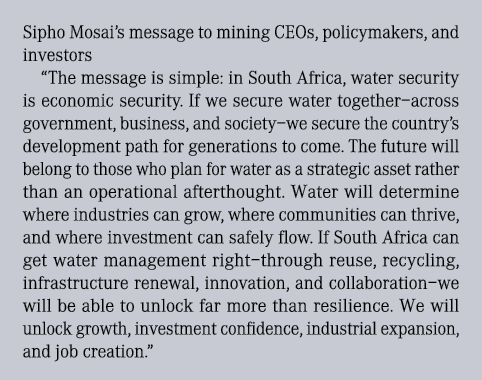
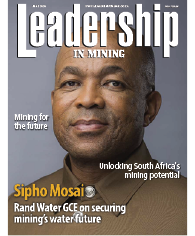
Ralph Staniforth sat down with Rand Water Group Chief Executive (GCE) Sipho Mosai to discuss his time at the helm of the water utility, how mining can assist in the battle to save water, and why we all need to collaborate now to ensure we future-proof our economy.
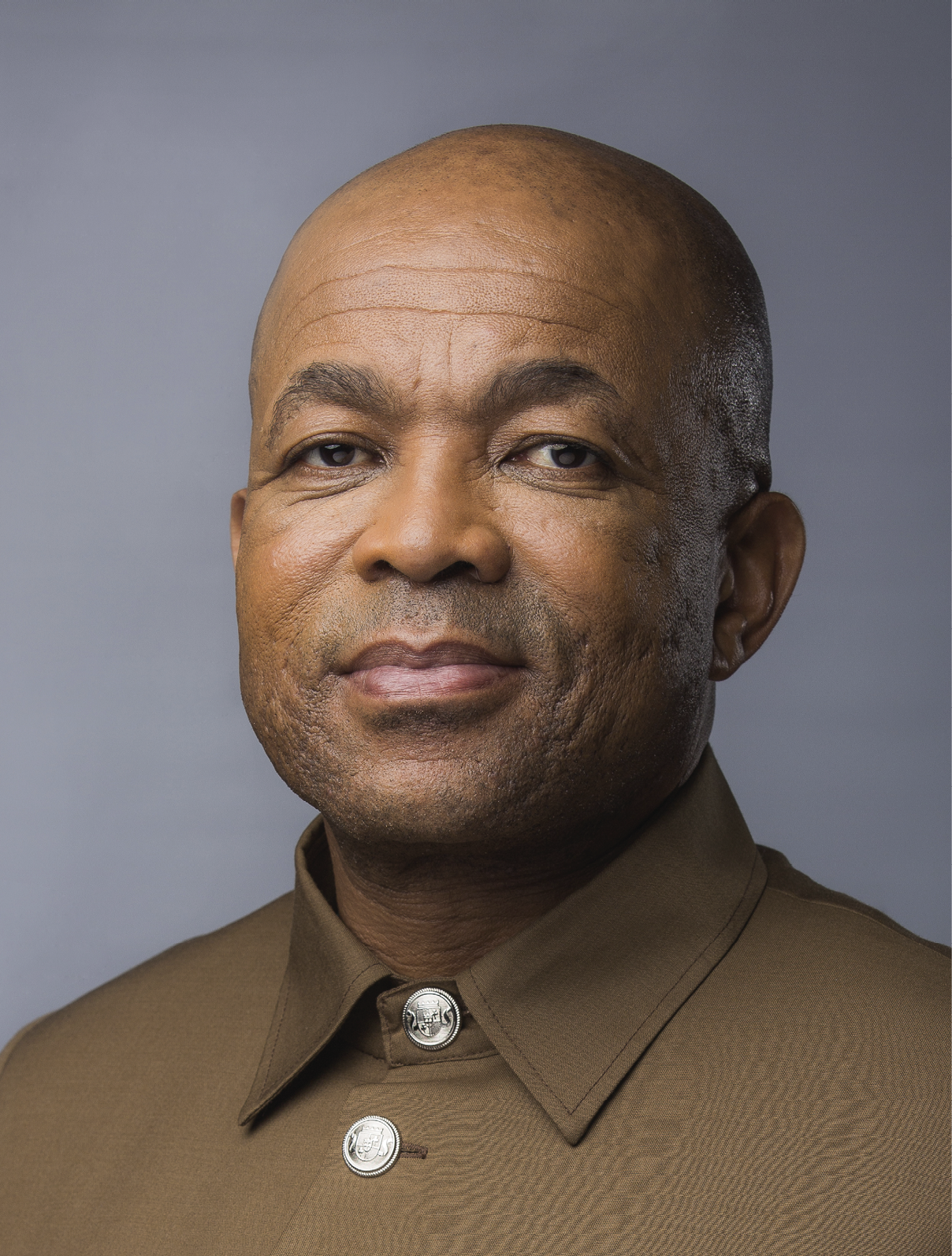
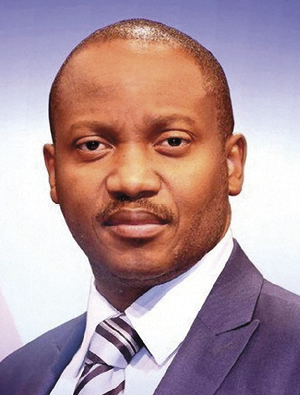
As the Group Chief Executive Officer of Rand Water since May 2019, Sipho Mosai’s leadership journey has been shaped by a combination of professional experiences, personal values, and a deep appreciation for the importance of public service.
One of the most influential experiences in his career has been working across different sectors of the water environment, where he has witnessed first-hand how access to reliable water directly affects people’s quality of life. These experiences taught him that infrastructure is not just about pipes, pumps, and treatment plants – it is about enabling economic growth, supporting communities, and improving livelihoods.
Another important influence has been leading teams through periods of complexity and change. The water sector faces challenges such as climate variability, ageing infrastructure, population growth, and increasing demand. Navigating these challenges has reinforced the importance of resilience, strategic thinking, and collaborative leadership in Mosai.
“I have learned that the best solutions emerge when people with diverse skills and perspectives work together toward a common goal,” he explains.
Mosai was raised with values of integrity, accountability, hard work, and respect for others. These principles continue to guide his decisions as a leader.
“I believe leadership is ultimately about service – creating an environment where people can perform at their best, making decisions that serve the public interest, and ensuring that future generations inherit sustainable water infrastructure and resources,” he shares.
“Leadership is not about individual achievement. It is about building capable institutions, empowering people, and leaving a lasting positive impact. At Rand Water, this means ensuring that we continue to provide reliable, high-quality potable water while contributing to South Africa’s broader development objectives.”
When looking back on his journey at Rand Water, Mosai shares that one of the defining turning points in his journey has been leading through periods where operational demands, , and stakeholder expectations converged at the same time.
This taught him that leadership is not just about managing assets–it is about managing complexity. The key lesson was that long-term success depends on strategic foresight, strong partnerships, and the ability to make decisive decisions under pressure.
“I think, most importantly, I’ve learned that every decision must balance today’s needs with tomorrow’s sustainability. That perspective continues to shape how I lead: with a focus on resilience, collaboration, and delivering lasting value to the people we serve and economy,” Mosai says.
As Rand Water sits at the centre of public service, economic growth, and industrial development, being a leader in this kind of high-pressure environment is not easy. It demands clarity, stability, and direction–all of which Mosai has brought to the table.
“Water is fundamental to communities, businesses, and economic growth, so every decision carries significant responsibility. I define leadership as the ability to balance immediate operational demands with long-term sustainability, while building trust among stakeholders and empowering teams to deliver results. It requires resilience, strategic thinking, and a commitment to serving the greater good,” Mosai continues.
“Ultimately, leadership is about ensuring that the decisions we make today strengthen the resilience and prosperity of the country for generations to come. We have fostered collaborations with the organisation’s municipal customers to ensure the provision of sustainable quality water quality and sanitation services. In turn, these engagements have resulted in the formation of the Rand Water Services, a subsidiary company with the sole purpose of executing special projects and water services business opportunities.”
By strategically investing in the maintenance of infrastructure, the development of new facilities, and embracing innovation, Rand Water is well-equipped to tackle the challenges of a changing environment, while ensuring millions have access to clean water.
Let the collaboration flow
As far as Mosai is concerned, strong collaboration with the government is essential to fulfilling Rand Water’s mandate. The organisation works closely with the Department of Water and Sanitation as a shareholder, sector leader, and policy partner to advance water security, infrastructure development, and sustainable resource management.
Constructive relationships are also maintained with departments such as the Department of Mineral and Petroleum Resources, recognising the critical role that water plays in supporting mining, energy production, and broader economic development.
“Our engagement is centred on ensuring that strategic industries have reliable access to water while safeguarding the sustainability of this vital resource. The foundation of these relationships is partnership, alignment, and a shared commitment to South Africa’s development goals. By working together across government and industry, we are better positioned to address challenges, unlock growth opportunities, and build long-term resilience for the country,” he explains.
Moreover, Rand Water has collaborated with municipalities that are facing significant financial strain and impacted by non-revenue water. This spirit of collaboration was evident when the Emfuleni Local Municipality (ELM) agreed to pilot an innovative water services delivery model known as the Special Purpose Vehicle (SPV) to lead the provision of water and sanitation services in the area.
The SPV will include shareholders such as Rand Water, the affected municipality, and other third parties willing to invest in upgrading, refurbishing, operating, and maintaining water services infrastructure. Profits generated by the SPV will be distributed to investors as dividends, according to the SPV’s dividend policy.
Municipalities will contribute to the SPV by transferring their water services assets, which will be assessed, valued, and migrated, to the SPV. The Rand Water stake will be determined by its capital injection. This entity will then manage its own assets, liabilities, rights, and resources, effectively ring fencing water services under its umbrella. For day-to-day operations, shareholders will appoint non-executive directors, who will then select the Chief Executive Officer or Managing Director of the SPV.
The SPV will generate revenue to cover all water provision costs, supported by a robust balance sheet and cash flows. It will be responsible for planning, operating, maintaining, refurbishing, and upgrading water and sanitation infrastructure, ensuring reliable, high-quality water supply for consumers.
“This reimagined model promises a more sustainable and efficient approach to managing water services, ensuring better infrastructure and service delivery for municipalities,” he adds.
The creation of the National Water Resources Infrastructure Agency (NWRIA) by the President of South Africa is another visionary intervention that will fundamentally reshape South Africa’s water sector future. NWRIA is a strategic national response to the urgent challenge of securing water for development, sustainability, and future generations. The new agency addresses this challenge directly by consolidating infrastructure financing, development, operations, and maintenance within a single state-owned entity. This integration is critically important because water infrastructure cannot be managed effectively through fragmented mandates and disconnected financial systems.
Challenges are part of the job
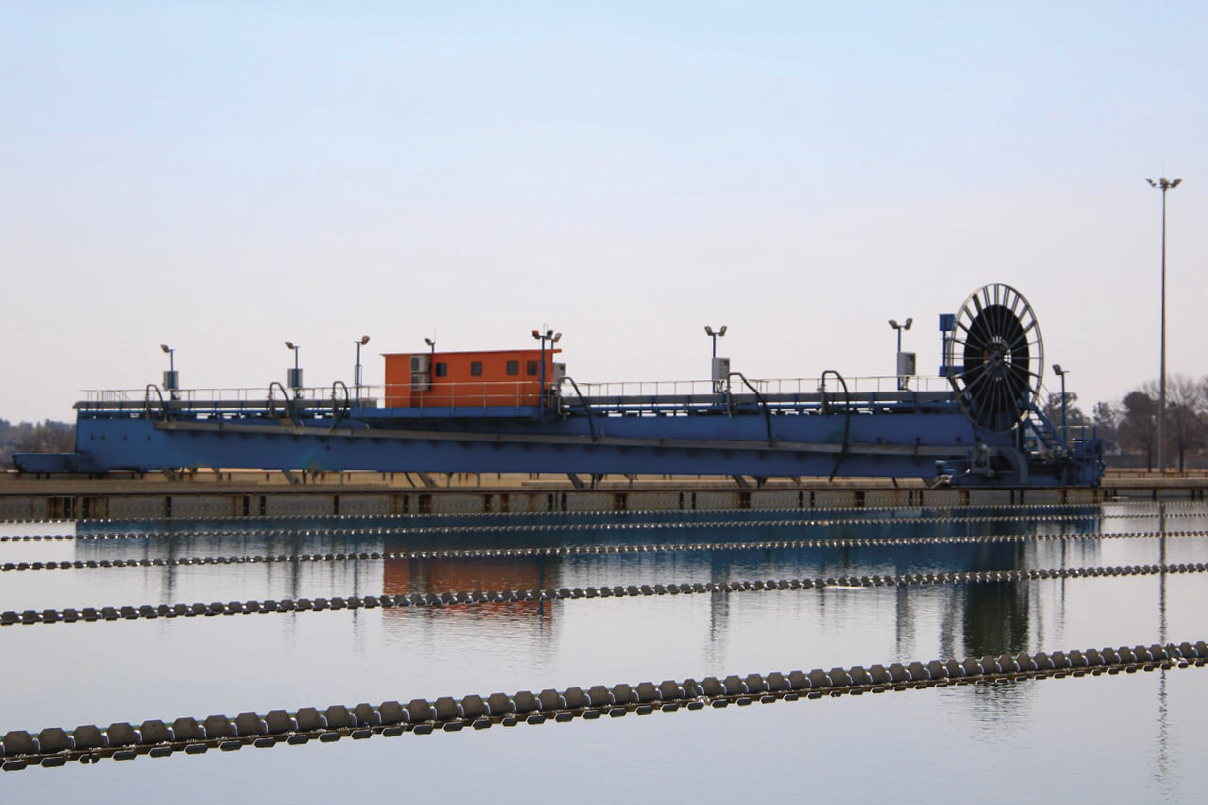
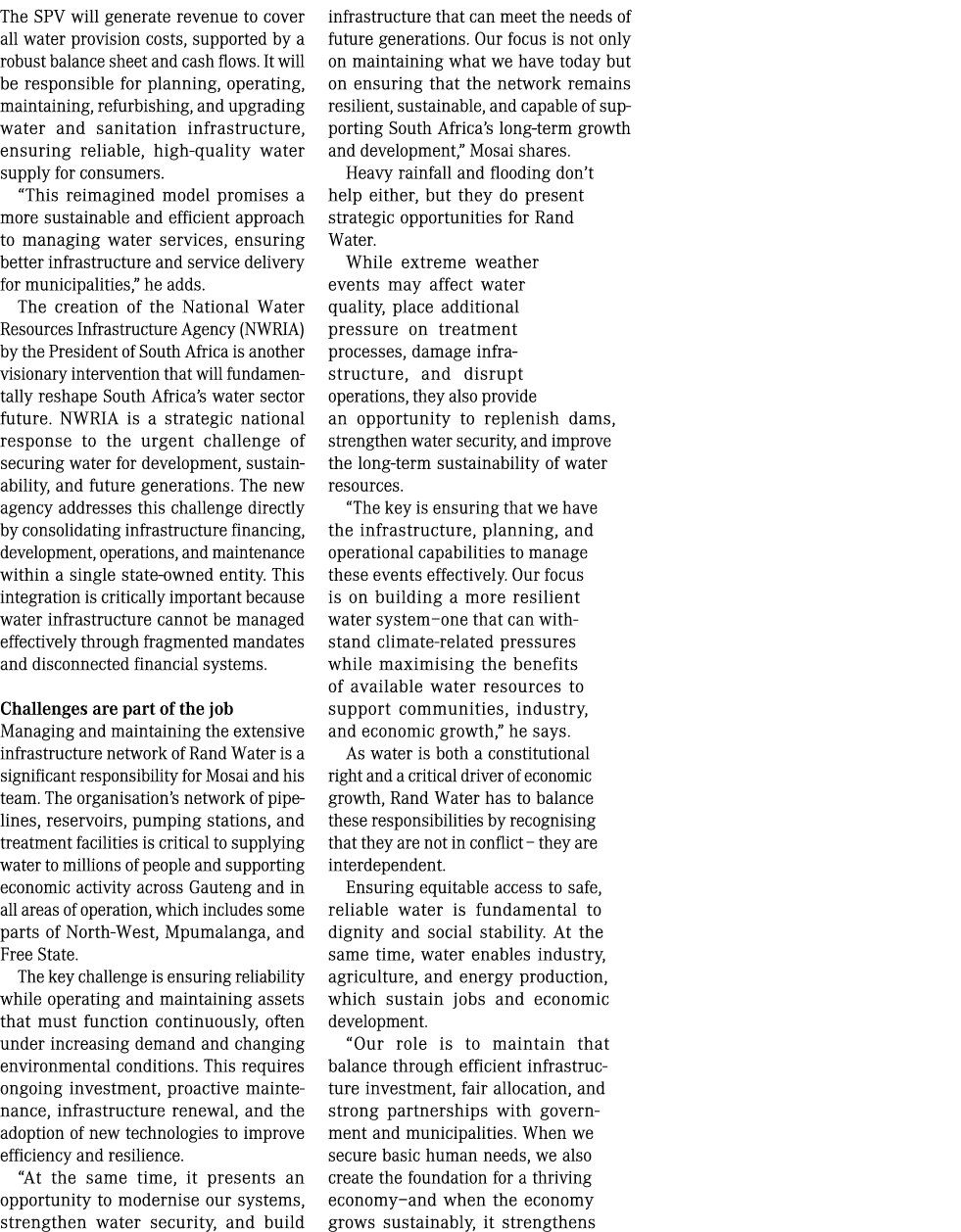
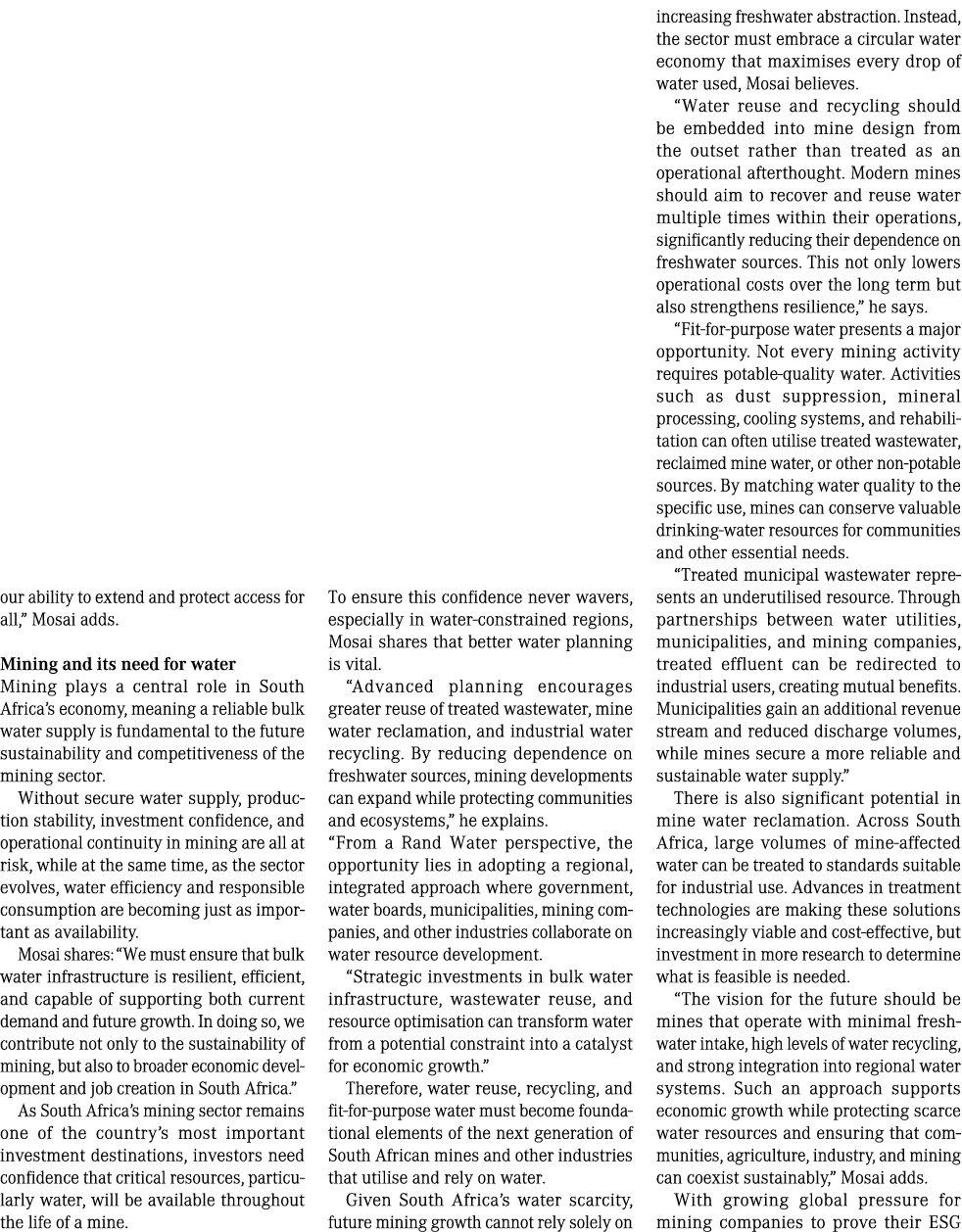
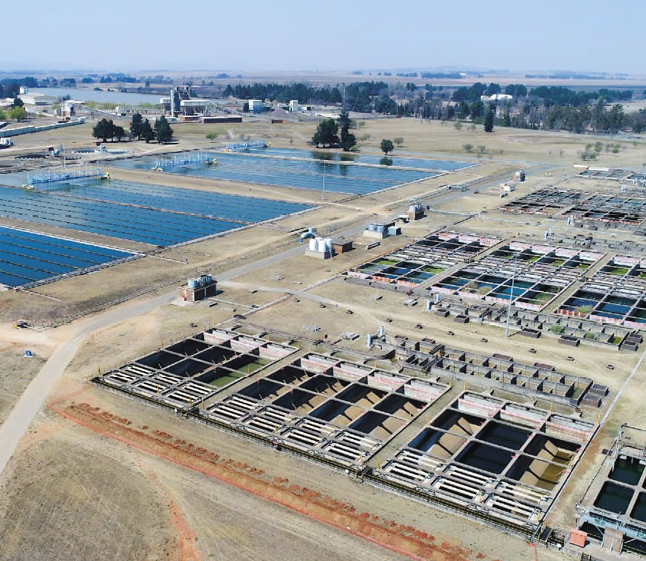
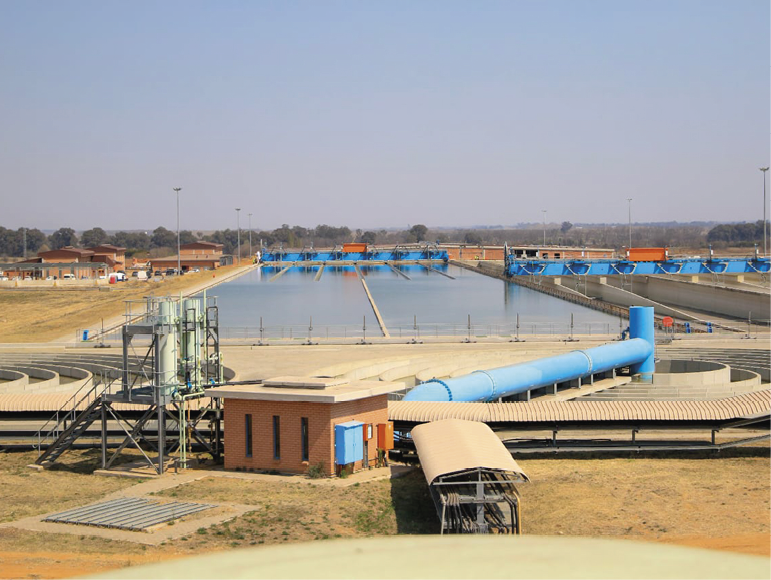
Managing and maintaining the extensive infrastructure network of Rand Water is a significant responsibility for Mosai and his team. The organisation’s network of pipelines, reservoirs, pumping stations, and treatment facilities is critical to supplying water to millions of people and supporting economic activity across Gauteng and in all areas of operation, which includes some parts of North-West, Mpumalanga, and Free State.
The key challenge is ensuring reliability while operating and maintaining assets that must function continuously, often under increasing demand and changing environmental conditions. This requires ongoing investment, proactive maintenance, infrastructure renewal, and the adoption of new technologies to improve efficiency and resilience.
“At the same time, it presents an opportunity to modernise our systems, strengthen water security, and build infrastructure that can meet the needs of future generations. Our focus is not only on maintaining what we have today but on ensuring that the network remains resilient, sustainable, and capable of supporting South Africa’s long-term growth and development,” Mosai shares.
Heavy rainfall and flooding don’t help either, but they do present strategic opportunities for Rand Water.
While extreme weather events may affect water quality, place additional pressure on treatment processes, damage infrastructure, and disrupt operations, they also provide an opportunity to replenish dams, strengthen water security, and improve the long-term sustainability of water resources.
“The key is ensuring that we have the infrastructure, planning, and operational capabilities to manage these events effectively. Our focus is on building a more resilient water system–one that can withstand climate-related pressures while maximising the benefits of available water resources to support communities, industry, and economic growth,” he says.
As water is both a constitutional right and a critical driver of economic growth, Rand Water has to balance these responsibilities by recognising that they are not in conflict – they are interdependent.
Ensuring equitable access to safe, reliable water is fundamental to dignity and social stability. At the same time, water enables industry, agriculture, and energy production, which sustain jobs and economic development.
“Our role is to maintain that balance through efficient infrastructure investment, fair allocation, and strong partnerships with government and municipalities. When we secure basic human needs, we also create the foundation for a thriving economy–and when the economy grows sustainably, it strengthens our ability to extend and protect access for all,” Mosai adds.
Mining and its need for water
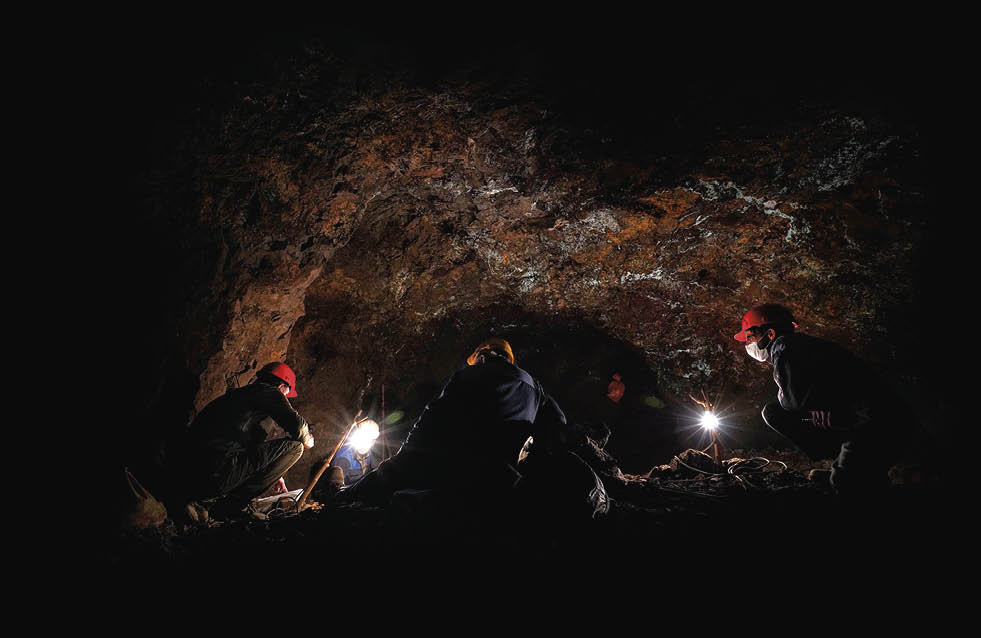
Mining plays a central role in South Africa’s economy, meaning a reliable bulk water supply is fundamental to the future sustainability and competitiveness of the mining sector.
Without secure water supply, production stability, investment confidence, and operational continuity in mining are all at risk, while at the same time, as the sector evolves, water efficiency and responsible consumption are becoming just as important as availability.
Mosai shares: “We must ensure that bulk water infrastructure is resilient, efficient, and capable of supporting both current demand and future growth. In doing so, we contribute not only to the sustainability of mining, but also to broader economic development and job creation in South Africa.”
As South Africa’s mining sector remains one of the country’s most important investment destinations, investors need confidence that critical resources, particularly water, will be available throughout the life of a mine.
To ensure this confidence never wavers, especially in water-constrained regions, Mosai shares that better water planning is vital.
“Advanced planning encourages greater reuse of treated wastewater, mine water reclamation, and industrial water recycling. By reducing dependence on freshwater sources, mining developments can expand while protecting communities and ecosystems,” he explains.
“From a Rand Water perspective, the opportunity lies in adopting a regional, integrated approach where government, water boards, municipalities, mining companies, and other industries collaborate on water resource development.
“Strategic investments in bulk water infrastructure, wastewater reuse, and resource optimisation can transform water from a potential constraint into a catalyst for economic growth.”
Therefore, water reuse, recycling, and fit-for-purpose water must become foundational elements of the next generation of South African mines and other industries that utilise and rely on water.
Given South Africa’s water scarcity, future mining growth cannot rely solely on increasing freshwater abstraction. Instead, the sector must embrace a circular water economy that maximises every drop of water used, Mosai believes.
“Water reuse and recycling should be embedded into mine design from the outset rather than treated as an operational afterthought. Modern mines should aim to recover and reuse water multiple times within their operations, significantly reducing their dependence on freshwater sources. This not only lowers operational costs over the long term but also strengthens resilience,” he says.
“Fit-for-purpose water presents a major opportunity. Not every mining activity requires potable-quality water. Activities such as dust suppression, mineral processing, cooling systems, and rehabilitation can often utilise treated wastewater, reclaimed mine water, or other non-potable sources. By matching water quality to the specific use, mines can conserve valuable drinking-water resources for communities and other essential needs.
“Treated municipal wastewater represents an underutilised resource. Through partnerships between water utilities, municipalities, and mining companies, treated effluent can be redirected to industrial users, creating mutual benefits. Municipalities gain an additional revenue stream and reduced discharge volumes, while mines secure a more reliable and sustainable water supply.”
There is also significant potential in mine water reclamation. Across South Africa, large volumes of mine-affected water can be treated to standards suitable for industrial use. Advances in treatment technologies are making these solutions increasingly viable and cost-effective, but investment in more research to determine what is feasible is needed.
“The vision for the future should be mines that operate with minimal freshwater intake, high levels of water recycling, and strong integration into regional water systems. Such an approach supports economic growth while protecting scarce water resources and ensuring that communities, agriculture, industry, and mining can coexist sustainably,” Mosai adds.
With growing global pressure for mining companies to prove their ESG credentials, water stewardship is becoming a determining factor as to whether mines are financeable and socially acceptable.
From a financing perspective, investors, banks, and development finance institutions are increasingly scrutinising how mining companies manage water-related risks. They want assurance that projects can operate sustainably in water-scarce regions, withstand climate-related disruptions, and avoid conflicts with surrounding communities.
As a result, a mine that cannot demonstrate responsible water management may face higher financing costs, stricter lending conditions, or difficulty securing investment altogether.
On the flipside, there is a growing recognition that water challenges cannot be solved by individual companies acting alone. Effective water stewardship requires collaboration among mining companies, water utilities, municipalities, regulators, and local communities. This in turn means that mines that actively participate in shared water solutions and contribute to regional water security are likely to earn greater trust from both investors and society.
“Looking ahead, I believe water stewardship will increasingly serve as a key indicator of mining sustainability. Just as safety performance became a non-negotiable measure of mining excellence, responsible water management is becoming a critical benchmark for investment decisions and public acceptance,” Mosai states.
“Ultimately, the mines that will attract capital and maintain their social licence to operate are those that can demonstrate that they are not merely consuming water, but actively helping to protect, manage, and sustain this vital resource for future generations.”
Infrastructure, innovation, and the future
One of the greatest challenges in the water sector is that infrastructure is largely invisible to the public. When people open a tap and clean water flows, it is easy to take for granted the immense systems and expertise required to make that happen every day. It is often only when there is a disruption that the true value of water infrastructure becomes apparent.
What Mosai wishes more South Africans understood is the sheer scale and complexity of the bulk water system that supports the economy and all our daily lives.
“Water must be sourced from dams and rivers, treated to stringent quality standards, pumped across vast distances, stored in reservoirs, and delivered through thousands of kilometres of pipelines. Much of this infrastructure operates continuously, 24 hours a day, 365 days a year,” he explains.
“The engineering involved is substantial. In many parts of the country, water must be pumped over long distances and significant elevations, requiring major energy inputs, sophisticated control systems, and highly skilled technical teams. Maintaining these systems is not simply a matter of fixing pipes when they break; it requires continuous monitoring, preventative maintenance, upgrades, and long-term planning. Bulk water infrastructure is capital intensive and designed to serve generations. Large pipelines, treatment plants, reservoirs, pump stations, require billions of rand in investment and often take many years to plan, finance, and construct.”
Unlike many other services, water infrastructure must often be built well before future demand materialises, which requires significant foresight and commitment. As an organisation, Rand Water has adopted a strategic vision focused on growth and sustainability, aimed at tackling existing water challenges and enhancing water distribution.
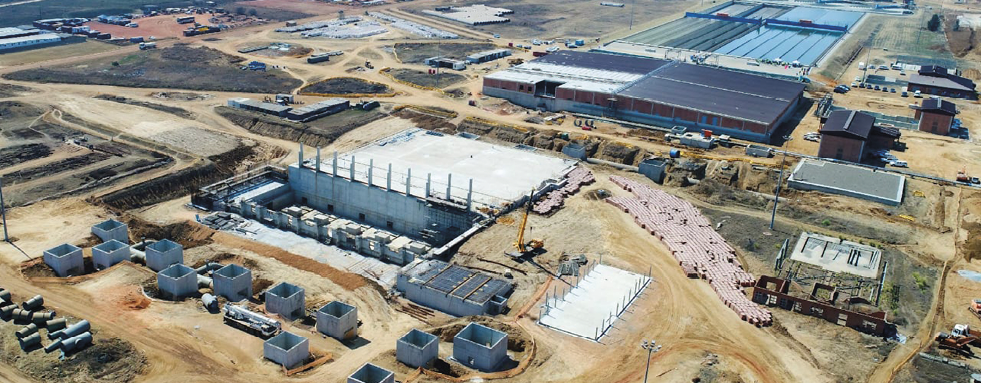
“This approach not only aims to improve access to water, but also ensures that resources are managed responsibly for future generations. As Rand Water, we focus on maintaining financial health while investing in state-of-the-art technologies and infrastructure and significant projects such as the construction of the biggest post tension reservoir in Vlakfontein Ekurhuleni at 210 million litres storage and the biggest purification plant since the dawn of democracy–the 600-million-litres-a-day Station 5A at Zuikerbosch Water Purification Plant.”
In servicing and maintaining water infrastructure, innovation is often required.
What excites Mosai the most is not any single innovation, however, but the convergence of several technologies and approaches that are transforming how water is managed.
“South Africa’s water challenges are complex, and there is no silver bullet. The future lies in combining innovation, infrastructure investment, and smarter resource management,” he says.
“Digital monitoring and data analytics are particularly promising because they enable utilities and water users to make better decisions in real time. Advanced sensors, smart metering, predictive maintenance systems, and digital twins can help identify leaks, optimise operations, improve asset management, and reduce water losses before they become major problems. In a water-scarce country, every drop saved matters.
“Leak detection technologies are equally important. Non-revenue water remains a significant challenge across many municipalities in South Africa. The No Drop certification measures water use efficiency in municipal drinking water distribution systems. It uses non-revenue water as a key performance indicator to gauge water wastage. The evaluation examines physical water losses (leaks), daily per capita water usage, strategies to reduce water losses, and the effectiveness of metering, billing, and revenue collection systems.”
According to the No Drop report independently produced by the Department of Water and Sanitation, only four Water Services Authorities achieved the certification by scoring 90%, a significant drop from 44 municipalities in 2014. The report also noted an increase in non-revenue water from 37% in 2014 to 47% in 2023 in South Africa.
Gauteng’s non-revenue water stands at 49.5%, one of the highest in the country. Dr Sean Phillips, Director General of Water and Sanitation, highlighted that the high levels of non-revenue water, including physical losses, in Gauteng contribute to water supply disruptions.
“Due to these high physical losses in municipal distribution systems, South Africa’s average per capita water consumption is approximately 218 litres per day, compared to the international average of 173 litres per day. Gauteng’s consumption is particularly high at 279 litres per day,” Mosai explains.
The report emphasised that Gauteng’s water interruptions are not due to a lack of bulk water provision, but rather high-water consumption driven by significant physical water losses in the municipal distribution system.
These challenges can be addressed through better operations, maintenance of water infrastructure, and effective implementation of water conservation, including demand management measures, but Mosai believes it is crucial that these interventions include education and awareness, pressure management, reduction of night flows, repairing leaks, revenue collection, and debt supervision.
“Any innovations that allow us to identify and repair leaks more quickly can unlock substantial water savings at a fraction of the cost of developing new supply sources. Rand Water Institute plays a vital role in driving innovation and research within Rand Water. The Institute has placed focus on developing cutting edge technologies and solutions to enhance water supply and management. It is establishing itself as a thought leader in the water industry locally and globally by encouraging collaboration and knowledge transfer,” Mosai shares.
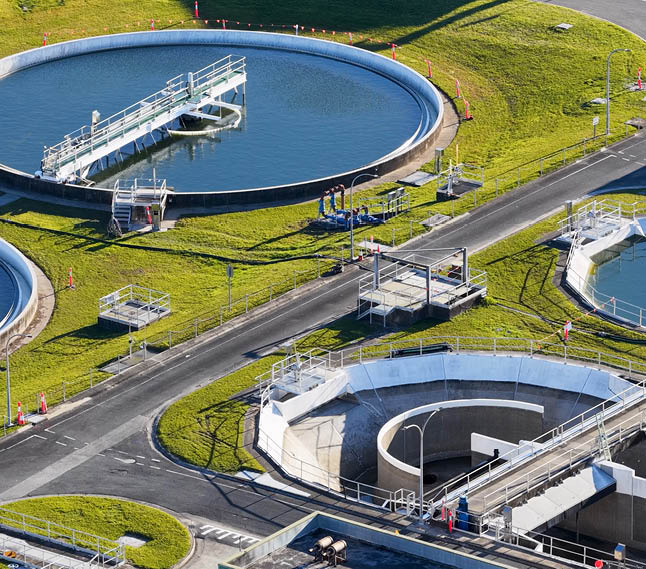
Mosai is also encouraged by advances in water reuse and recycling. Around the world, treated wastewater is increasingly being recognised as a valuable resource rather than a waste product. For South Africa, expanding water reuse presents one of the most practical and sustainable ways to improve water security while reducing pressure on freshwater resources.
“Ultimately, the innovation that excites me most is the shift toward a circular water economy–one in which water is reused, recycled, recovered, and managed as a strategic resource. The future of water security will depend not only on finding new sources of water but on using existing resources more intelligently, efficiently, and sustainably than ever before,” he adds.
Looking ahead 10 to 20 years, Mosai has a strong vision for Rand Water’s role in supporting a more water-secure, industrially competitive, and sustainable South Africa, but he was cautious in saying that leading in the water sector comes with a unique responsibility.
“The services we provide are essential to public health, economic activity, and the daily lives of millions of people. When everything works well, it is often taken for granted. When something goes wrong, it is immediately visible and rightly attracts public attention. That reality can create significant pressure for our teams,” Mosai explains.
“My approach is to continually remind our people of the purpose behind what they do. Every employee, whether they work in operations, engineering, communication, maintenance, finance, laboratories, or customer services, contributes to delivering a service that society simply cannot function without.
“I also believe that people perform best when they understand the bigger picture. We make a conscious effort to connect individual roles to Rand Water’s broader mission. When employees see the impact of their work, they are more motivated to overcome challenges and remain committed during difficult periods.”
Equally important is creating a culture of trust, accountability, and continuous learning for Mosai. The water sector is evolving rapidly, and his teams need opportunities to develop new skills, embrace innovation, and contribute ideas, as empowering people to solve problems and take ownership of outcomes strengthens both performance and engagement.
“Ultimately, motivation comes from purpose. Our teams understand that what they do is not just a job–it is a public service of national importance – and a calling to serve. Knowing that millions of South Africans rely on the work we do every day creates a powerful sense of responsibility and pride. That shared commitment to serving the country is what keeps our people focused, resilient, and motivated, even in the most demanding circumstances,” Mosai concludes.
Ralph Staniforth is a freelance writer.